Bhotekoshi flood damage estimated to cost $4.77 billion to rebuild
In the meeting of the Law, Justice and Human Rights Committee, there was a serious discussion about disaster management, protection of human rights and climate justice in the Bhotekoshi flood-affected areas in Rasuwa. Executive Head of National Disaster Risk Reduction and Management Authority Dr. Dharmaraj Upreti said that due to climate change, the risk of extreme weather events has increased in Nepal and informed that about 4.77 billion US dollars will be needed for damage assessment, restoration and reconstruction.

Primary Indicators & Data Highlights
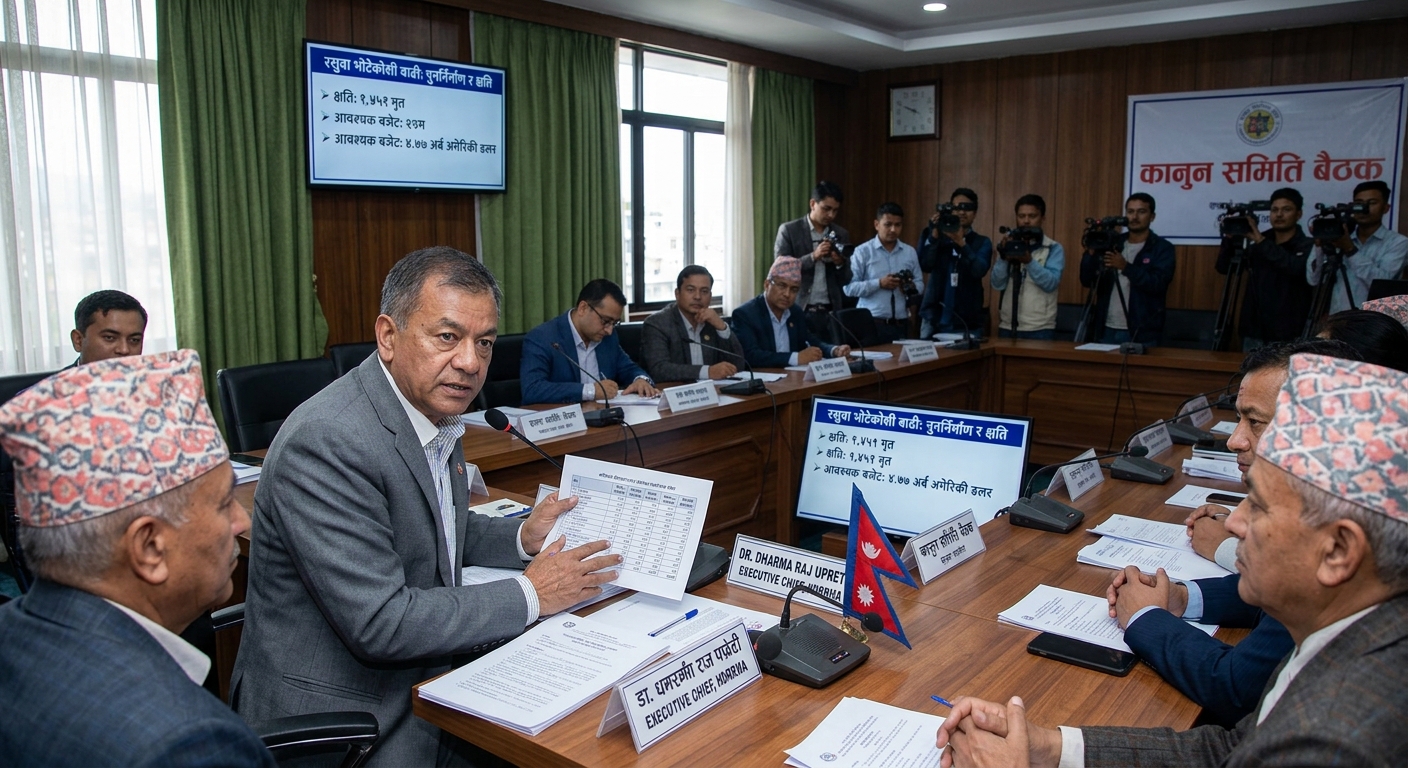
Kathmandu. In the meeting of the Law, Justice and Human Rights Committee, the issues of disaster management, protection of human rights of affected citizens and climate justice were discussed in the Bhotekoshi flood-affected areas in Rasuwa.
In the meeting, the executive head of the National Disaster Risk Reduction and Management Authority, Dr. Dharmaraj Upreti said that the risk of extreme weather events is increasing in Nepal due to climate change. He mentioned that in the last five-six years, Nepal has been facing major disasters and said that more technology and innovation is needed to mitigate and adapt to the effects of climate change.
He said, "In the past five to six years only, we have seen such large-scale disasters, but the impact of climate change is increasing in Nepal. We have also made strategic plans to reduce the impact of climate change. But sometimes we want to inform everyone here that we have many plans like the National Adaptation Plan, the NDC made in terms of how much emissions to reduce in terms of climate, and then the Disaster Risk Reduction and Management Strategic Plan, we have many plans and they are being implemented.
Upreti said that the Government of Nepal is working to reduce and adapt to the effects of climate change through the National Adaptation Plan, National Determined Contribution (NDC) and strategic plans related to disaster risk reduction and management. However, he said that more preparations are needed to address the extreme weather events seen recently.
According to the information available, 1,451 people died in the flood. According to him, 13 thousand 784 people have been rescued. Among the dead, 336 women, 579 men and 530 people were identified through DNA testing, he said. Among the relatives of the deceased, 1,997 people gave DNA samples.
According to him, so far 5 thousand 786 people are missing. He informed that there are 636 foreign nationals among the missing.
After the flood, 37 holding centers were established to keep the affected people, but now the number has reduced to 20. As of yesterday, 1,661 people were in the holding center. Among them, 324 are in Nuwakot, 786 in Rasuwa and 121 in Dhading, Upreti said.
He said that after the government decided to provide 15,000 rupees per month for house rent to the affected families, the number of people living in holding centers has decreased as many affected families have shifted to rented houses. Arrangements have been made to provide house rent at the rate of Rs 15,000 for a family of up to four members and Rs 2,000 for each additional member.
The victim also informed that 20 thousand 929 security personnel were deployed for search, rescue and relief after the flood.
After the flood, the government formed a 14-member technical team and made an initial assessment of the damage using drones and other technologies. The said team prepared Rapid Damage and Need Assessment (RDNA) report within 15 days.
According to him, it is estimated that about 4.77 billion US dollars will be needed for the flood damage and reconstruction and rehabilitation
He said, "In terms of our total loss and how much we need now for the reconstruction, we have estimated almost there." We have established that an amount equivalent to 4.77 billion US dollars is needed now, and in terms of damage, we have also put a figure on how much loss and how much loss there is.
All figures and disclosures cited in this dispatch are cross-verified against official documents, institutional releases, and primary verified sources.